
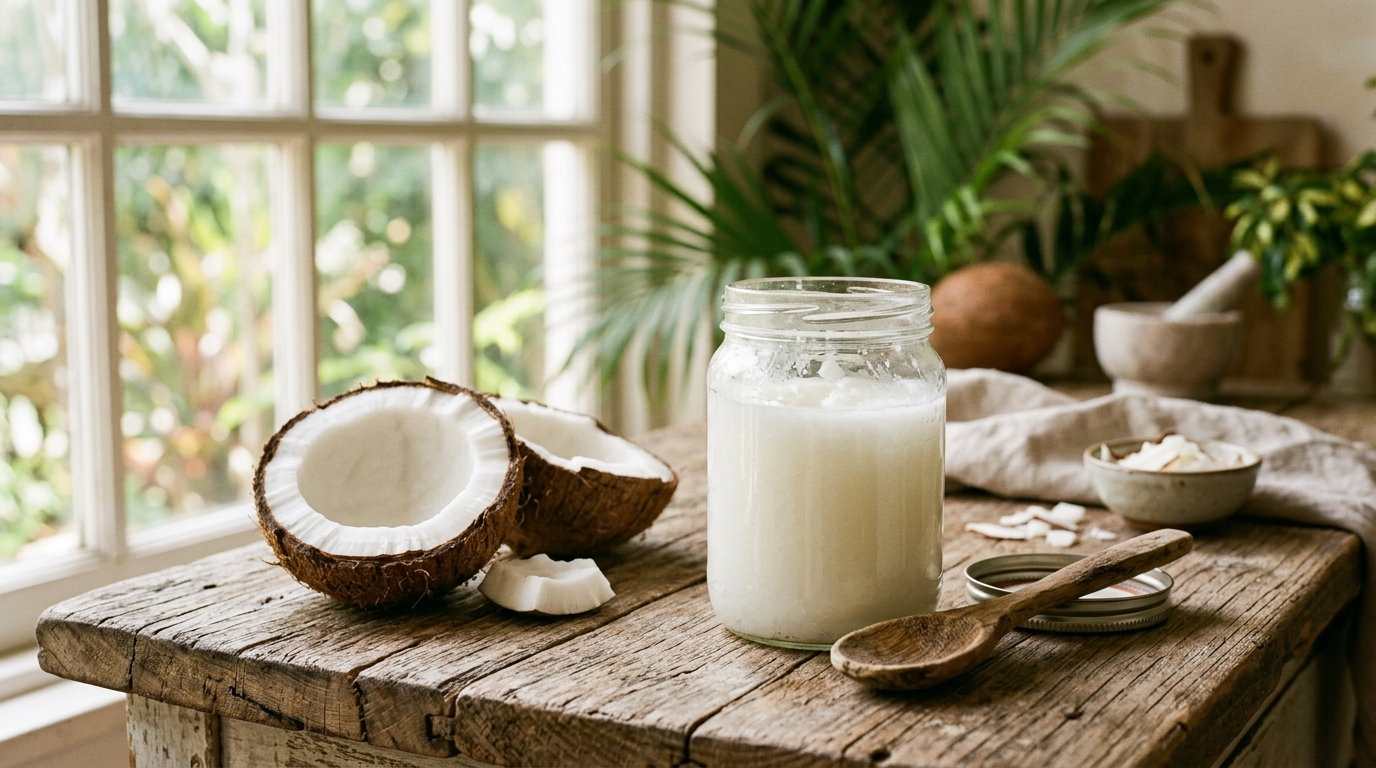
A simple ingredient that's been in kitchens around the world for decades
Coconut oil has gone from being an exotic product to sitting in countless pantries. And for good reasons: it's stable at room temperature, holds up well to kitchen heat, and has a fat profile that's different from what we're used to in Europe.
In this article we tell you what we do know about coconut oil — without exaggerated promises — and how it fits into a balanced diet.
What kind of fat it is
Coconut oil is made up mostly of saturated fats. The word "saturated" often raises an alarm, but a small caveat is worth making: not all saturated fats are alike.
What's particular about coconut oil is that a good portion of its fats are medium-chain triglycerides, known by their abbreviation MCT. These are shorter fatty acids than the typical ones found in butter or olive oil, and because of their size the body processes them slightly differently from most other fats.
This isn't a health promise — it's basic chemistry of the product. Much of the interest in coconut oil in both cooking and supplements comes from that particular composition.
How to choose a good coconut oil
If you're going to buy coconut oil — for cooking or as an ingredient — it's worth paying attention to these details:
- Organic, no pesticides.
- Virgin or extra virgin, ideally cold-pressed (preserves more of the aroma).
- No chemical solvents in the process.
- No colourings, no preservatives, no added flavours.
A good coconut oil doesn't need refrigeration to stay in good condition, which makes it a practical ingredient. At cool temperatures it solidifies; at warmer temperatures it turns liquid — both states are normal. The texture changes, the properties don't.
What coconut oil is used for in the kitchen
One of coconut oil's most practical features is that it holds up well to heat — its smoke point is relatively high compared to other oils. That makes it versatile:
- For gentle sautéing or frying, where other oils start to break down sooner.
- For baking — it works well as a substitute for butter in many recipes.
- For smoothies, on toast, or as a small spoonful in coffee.
- Some people also use it externally, on skin or hair.
As with any fat, the sensible approach is to use it in moderation and within a balanced diet. A tablespoon or two a day can be a comfortable amount to start with.
Coco-10 Plus®: NaturalSlim's coconut oil
At NaturalSlim we work with a coconut oil that we enrich with coenzyme Q10 (CoQ10), a substance the body produces naturally and which is also present in some foods. The product is called Coco-10 Plus®.
Coco-10 Plus® is intended as a supplement, not as a cooking oil. For frying or cooking, the best option is a high-quality culinary-grade virgin organic coconut oil — easily found in most supermarkets.
If you're considering adding it to your routine, the usual approach is to start with half a tablespoon a day and increase gradually based on individual tolerance. People who notice they're more sensitive to fats (what at NaturalSlim we call an "excited" metabolism — see our article on the two sides of metabolism) tend to stay at lower amounts.
What coconut oil is NOT
To be honest with our readers: coconut oil is not a medicine and not a miracle solution. It doesn't "cure", it doesn't "detoxify", and it doesn't replace a balanced diet, enough sleep and daily movement. What it is: an ingredient with a particular profile, versatile in the kitchen, that many people enjoy adding to their routine.
If you'd like personalised guidance on how to integrate this — or any other product — into your routine within the NaturalSlim approach, our team of Certified Metabolism Consultants at NaturalSlim Europe is here for you.



Share:
The passive nervous system: what it is and how to balance it
What magnesium citrate is for: benefits, uses and what you need to know